How to Manage Multi-Day Dive Course Logistics Without Losing Your Mind
<b>TL;DR:</b> Multi-day dive courses demand synchronized tracking of student progress, instructor schedules, equipment, and paperwork across multiple sessions. Cloud-based management software centralizes data, automates onboarding, links segmented sessions, tracks gear in real-time, and standardizes procedures. This approach prevents double-bookings, lost paperwork, and gear shortages while recovering revenue lost to operational chaos.
Key Takeaways
- Centralize all course data in one cloud platform to eliminate double-bookings and communication gaps
- Automate student paperwork with digital waivers and medical forms completed before arrival
- Use segmented scheduling that automatically links pool sessions, classroom time, and open water dives
- Track equipment digitally in real-time to prevent last-minute gear shortages between sessions
- Standardize instructor briefings and skill assessments while preserving teaching personality
Why Do Tuesday Pool Sessions Turn Into Thursday Morning Crises?
Picture this familiar scenario. Your instructor shows up to the dock for a Thursday morning open water checkout dive. They do a quick roll call and check the manifest. Half the students are missing their required confined water skill sign-offs.
The Tuesday evening pool session happened. The students completed the skills. The paperwork simply never made it from the wet pool deck to the main office.
Single-day dive trips are straightforward. You book a diver, hand them tanks, and take them to a reef. Multi-day dive course logistics introduce exponentially more moving parts.
These certification courses account for significant revenue for your shop. Progress in the first session directly dictates what happens in the next three. Getting this workflow right matters for your profitability and your safety margins.

Why Do Multi-Day Dive Courses Create So Many Logistical Headaches?
Multi-day courses are not isolated calendar events. They function as a continuous chain. The progress a student makes on Monday completely gates their access to Wednesday.
You have multiple dependencies overlapping at the exact same time. Instructor availability must align with gear turnover between sessions. You also have physical location changes as students move from the classroom to the pool and out to the open ocean.
<b>Key challenge:</b> Communication gaps plague manual tracking systems. Office staff, boat crews, and instructors all need the exact same information at different times.
A student might have sessions spaced three to five days apart. This spacing creates memory gaps when you rely on manual tracking or whiteboards.
Operational inefficiencies cost dive businesses real money. A single missed medical form can stop a student from completing their certification entirely. This wastes days of valuable instructor time and leaves an empty seat on your boat.
What is the Single Biggest Mistake Dive Centers Make?
Fragmenting Your Data Across Multiple Systems
<b>Common mistake:</b> Using disconnected tools for a single continuous workflow causes massive operational friction.
Dive centers frequently use spreadsheets for their master schedule. They use paper clipboards for waivers. They rely on group text messages for instructor communication. They keep paper binders for equipment service logs.
When an instructor updates a student's progress on paper, the boat crew preparing for the next session remains in the dark. The cascade effect of this fragmented data is brutal.
Imagine a Tuesday night pool instructor marking a student as needing more practice with mask clearing. The Thursday boat captain does not find out about this delay until the boat is already idling at the dock.
Double-bookings happen naturally when scheduling lives in one person's head or across mismatched physical calendars. The dive industry runs on tight margins, and you cannot afford to send an instructor to the wrong location.
How Should You Centralize Multi-Day Course Data?
Building Your Single Source of Truth
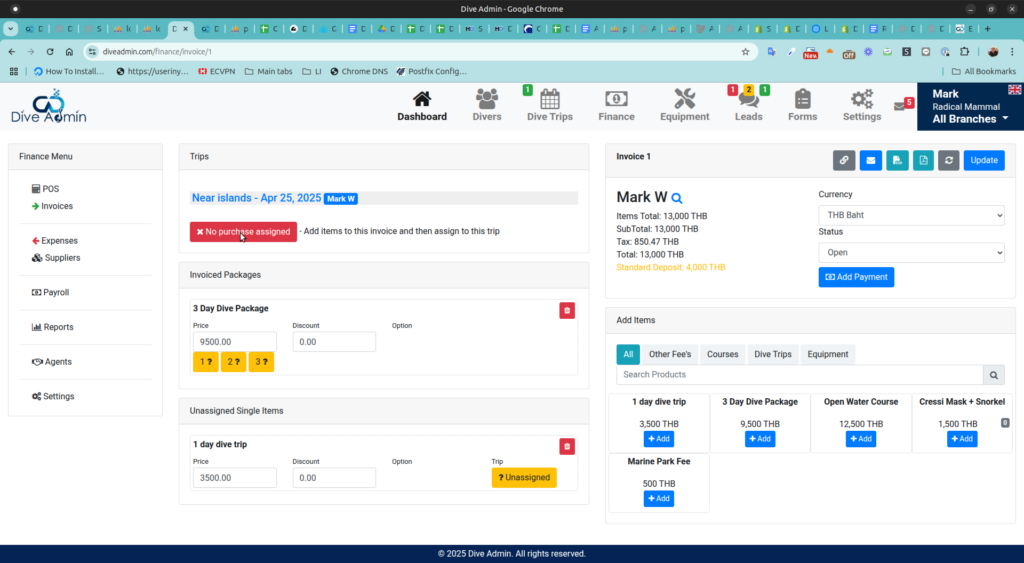
Cloud-based dive center management platforms offer a direct solution to the fragmentation problem. A single source of truth means your scheduling, student records, equipment logs, and instructor notes all live in one unified system.
<b>Bottom line:</b> Real-time updates must be visible to all team members instantly regardless of their physical location.
When an instructor logs a skill from their phone at the pool, the front desk and the boat crew see the update before the instructor even drives back to the shop.
This transparency transforms your operation. Office staff stop chasing instructors for updates. Instructors stop calling the office to check their schedule for the following morning.

How Can You Eliminate Student Paperwork Bottlenecks?
Automating the Onboarding Process
Manual paperwork kills efficiency. Having eager students fill out medical forms on clipboards in a crowded retail space causes unnecessary delays and creates liability risks.
<b>Step 1:</b> Move digital waivers and medical questionnaires to the very start of the process. Students should complete these forms online before they ever step foot in your shop.
Dive centers typically save hours of admin time per week by digitizing student paperwork. Automated systems flag expiring medicals or missing consent forms well in advance.
Quarterly automated reports completely replace the chore of spelunking through filing cabinets. You can instantly generate a manifest showing who has completed their required documentation.
Medical red flags surface early instead of causing a scene right before the boat departs. If a student needs a doctor's clearance for a heart condition, you find out on Tuesday rather than Friday morning.
What Makes Multi-Day Scheduling Different from Single-Day Trips?
Mastering Segmented Interconnected Workflows
Multi-day courses are linked workflows rather than isolated calendar events. You cannot treat an Open Water certification course like a standalone afternoon boat charter.
<b>When to use this:</b> Segmented scheduling connects a Tuesday pool session automatically to a Thursday open water dive for the same exact student group. The system should physically prevent assigning a student to day three if they have not completed their day two requirements.
Give your instructors their own logins to view assignments and submit their availability. Instructor self-service scheduling reduces endless text message chains and gives your team autonomy.
An effective system links Day 1 classroom work, Day 2 confined water sessions, and Day 3 open water checkouts to the same student cohort. This eliminates the need to manually re-enter names for every single session.
How Do You Track Equipment Across Multiple Course Sessions?
Treating Gear as a Dynamic Asset
The exact same gear rotates from the classroom to the pool and then to the boat. Equipment moves through five to seven different states during a multi-day course.
A regulator gets assigned to a student. It gets used in the pool. It goes into the wash tank. It hangs up to dry. Eventually, it needs routine service.
<b>Smart strategy:</b> Digital equipment management tracks service history and real-time availability simultaneously. Digital logs replace paper service cards that inevitably go missing between wet environments.
Office staff can instantly see exactly what regulators are available for tomorrow's open water dive. They do this without ever needing to call the boat captain to count physical units.
Treating gear as a dynamic asset prevents last-minute scrambles. You never want to tell a paying student that you do not have a medium wetsuit available because it is still wet from yesterday's class.
Why Do You Need Standardized Instructor Procedures?
The Playbook Approach to Consistency
Standard operating procedures keep your staff safe, but they also ensure a consistent student experience across multiple days.
The playbook concept provides a standardized framework for briefings, equipment checks, and skill assessments. You can still balance this standardization with individual instructor personality and teaching style.
> "Learning isn't just about giving the right answer at a specific point in time; it's about ensuring that knowledge is retained and applied in real-world situations. Consistency in how we evaluate that learning is crucial."
> — Mark Powell, Director of Global Training at Scuba Diving International (SDI), 2025
A student on day four should receive the exact same professional experience as day one. This applies even if a different instructor takes over the final checkout dives.
Standardized skill assessment checklists prevent eager students from advancing before they are genuinely ready. It removes the guesswork from the training progression.
What is the Real Business Impact of Getting This Right?
Professional operations drive repeat business for advanced certifications. Relying on digital systems allows centers to handle twice as many concurrent multi-day courses without adding more admin staff.
You can easily justify the investment in new systems by looking at concrete return on investment. Recovering that lost revenue fundamentally changes your profit margins.
Research from the Dive Equipment & Marketing Association (DEMA) consistently highlights that operations adopting streamlined digital workflows see higher customer retention. When the logistics fade into the background, students focus purely on the joy of diving.
This operational smoothness builds trust. It turns a stressed open water student into a lifelong customer aiming for their divemaster certification.
FAQ
How much does dive center management software cost?
Pricing models typically range from $50 to $500 per month depending on the size of your center. Some platforms charge a flat monthly subscription while others take a small per-booking fee. The cost usually pays for itself quickly when compared to the admin hours saved and the revenue recovered from better scheduling.
Can we implement these systems gradually?
You do not need to change everything overnight. A phased implementation approach works best. Start with student paperwork automation, then add scheduling, and finally introduce equipment tracking. A full transition usually takes two to four months for most standard retail operations.
What happens if our internet goes down during a course?
Modern cloud systems feature offline mobile apps. The data syncs seamlessly as soon as the connection restores. This setup includes backup procedures for critical information and remains significantly more reliable than paper systems that can get lost or water damaged on a boat.
How do we get instructors to actually use new systems?
Show your instructors how the software directly reduces their admin burden. Mobile-friendly interfaces make compliance easy. Involve your lead instructors in the system selection process early so they feel ownership over the new tools rather than feeling micromanaged.
Do these systems work for small dive centers?
Scalable solutions exist for two-person shops up to massive 50-employee operations. Small centers actually benefit proportionally more from the time savings because owners wear so many hats. Starting a digital transition now prevents painful operational bottlenecks later as your course volume grows.