How to Increase Dive Center Revenue Without Adding Boats (Proven Strategies)
The most profitable dive center revenue stream isn't adding more boat trips. You generate significantly more income by increasing what each customer spends through high-margin services like private guiding, specialty course bundles, and underwater photography packages. With typical dive shop margins sitting tightly around 8-15%, these value-added experiences boost revenue by 30% or more without expanding boat capacity or adding operational costs.
<b>Key Takeaways:</b>
- Full boats with thin margins mean you're working harder without scaling profits
- Customers buying courses and gear return significantly more often than one-time divers
- Private guiding and photo packages generate incredible margins compared to standard dives
- Automated platforms eliminate massive monthly revenue leaks from unbilled rentals
- Modern divers expect personalized service and will gladly pay for VIP treatment

Why Are Most Dive Centers Stuck With Low Profit Margins?
Most dive operations run on razor-thin margins because they compete solely on price. Fixed costs like boat maintenance, insurance, and staff salaries eat up the bulk of your revenue. You hit a capacity ceiling quickly when physical limitations like boat size and available time slots cap your growth.
The average dive center operates on 8-15% profit margins. This sits significantly below the 20-25% typical of successful hospitality businesses.
Common mistake: Competing in a race to the bottom by discounting standard boat seats. The dive centers actually thriving right now aren't selling more dives. They sell more to each diver.
What Is the Highest-Margin Dive Center Revenue Stream?
Value-added services easily outperform volume-based boat trips. A standard dive trip might cost $100 per person at a 10% margin, leaving you with just $10 in profit. A private guided dive often commands $400 per couple at a 50% margin, handing you $200 in pure profit.
Key takeaway: High-margin revenue streams require zero extra boat space.
Top overlooked revenue streams include:
- Premium private guiding
- Specialized course bundles
- Photography and media packages
- Equipment add-ons and retail upselling
These offerings shift your business from a commodity provider to a premium experience curator.
How Can Private Guiding Transform Your Revenue Model?
Premium private guiding means moving beyond the standard instructor ratios of four-to-one or six-to-one. Divers gladly pay premium prices for personalized attention, flexible schedules, and customized site selection.
Pricing strategy: Charge appropriately for the exclusivity. A standard dive might cost $100 per person, but a private VIP guide runs $300 to $500 for one or two divers. A dive center converting just two group divers per week to private guiding adds more than $20,000 annually with minimal additional cost.
Train your staff to identify customers who value this premium experience. Honeymooners, nervous beginners, and underwater photographers are prime candidates for VIP treatment.

Why Do Specialty Courses Outperform Standard Certifications?
Commoditized Open Water courses often suffer from intense price competition. Specialty courses attract committed divers who want to invest heavily in their hobby.
Divers who complete specialty certifications spend significantly more on equipment and dive travel over their lifetime compared to basic-certified divers.
Bottom line: Bundle specialties with adventure experiences to maximize revenue.
Examples of profitable bundles include:
- Deep and Wreck diver combo packages
- Underwater Photography combined with a guided photo safari
- Drift and Navigation training for adventure travelers
Don't discount these bundles. Add value instead by including specialized rental gear or personalized debriefing sessions. Digital platforms like Dive Admin help track which students are ready for their next level of training.
How Much Can Photography Packages Actually Add to Revenue?
Photography feels niche to some operators, but most divers want professional photos without the hassle of buying and mastering camera equipment. You can monetize this demand with near-zero marginal cost using digital delivery.
> "Divers today are looking for tailored experiences, not just a crowded boat ride. When you offer specialized photography workshops or premium private guiding, you aren't just increasing your margin per diver. You're creating a loyal customer who will return specifically for the level of service you provide." — Andy Phillips, PADI Platinum Course Director and dive business consultant
Three effective monetization models exist:
- <b>Underwater photo guide services:</b> Add a $150 to $300 premium per dive for a dedicated photographer
- <b>Post-dive media packages:</b> Sell professional photo editing and delivery for $50 to $150
- <b>Photography training workshops:</b> Offer a specialty course with guided practice for $400 to $600
You don't need a massive equipment investment. Partner with local freelance photographers or rent out basic camera rigs to students.
What Equipment Add-Ons Actually Sell?
Shift your retail mindset away from heavy gear like BCDs and regulators. High-turnover impulse buys solve immediate problems for divers and generate 35-50% margins.
Top retail add-ons include:
- Reef-safe sunscreen and anti-fog solutions
- Dive apparel like rashguards and branded hats
- Safety accessories including surface markers and whistles
- Comfort items such as padded mask straps and mouthpiece upgrades
Placement strategy: Position these small-footprint items near your checkout desk or boat boarding area. Divers happily pay a convenience markup to buy these items right on-site. Train your staff to naturally recommend one relevant item per customer during the check-in process.
How Do You Stop Revenue Leaks in Daily Operations?
Many dive centers fall into the busy trap. The boats are full and the staff is exhausted, but money mysteriously disappears before the end of the month.
Common revenue leaks include:
- Unbilled rental equipment given out at the last minute
- Missed add-on opportunities for nitrox or private guides
- Manual booking errors and double-bookings
- No-shows from customers who never paid a deposit
Industry experts frequently note that small operational inefficiencies compound over time. Losing $2,000 to $5,000 monthly is typical for centers operating without integrated software systems.
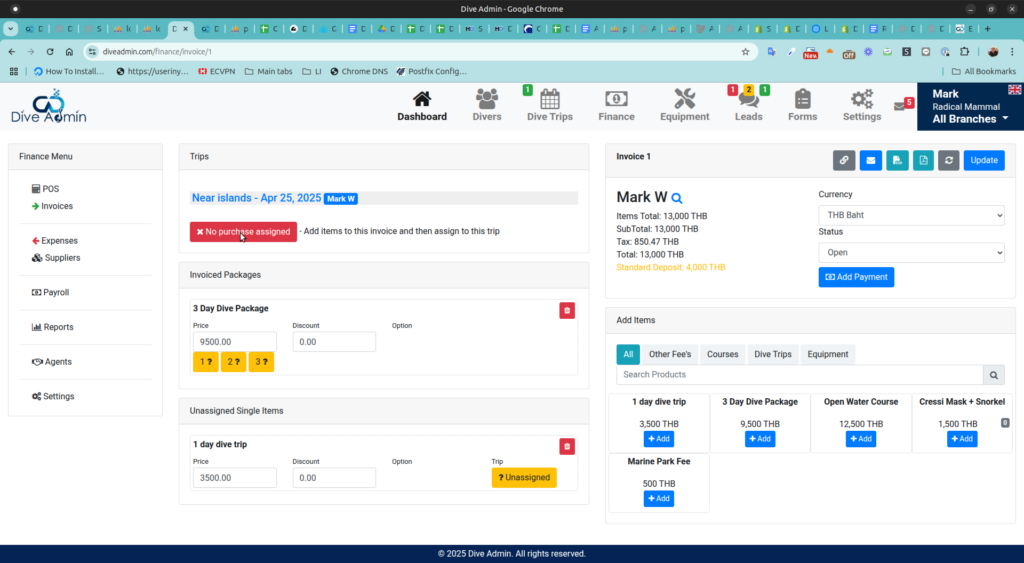
Solution: Digital operations platforms stop the bleeding. Tools like Dive Admin feature automated invoicing to capture every single rental item. Integrated booking prevents scheduling errors, and the customer database flags instant upsell opportunities for your staff.
Why Focus on Customer Lifetime Value Instead of Single Trips?
Customer Lifetime Value (CLV) measures the total revenue a person generates over their entire relationship with your business. A one-time diver might spend $200, but a returning diver who takes three courses, buys gear, and books annual trips will spend $3,000 to $5,000 or more.
When to use this: Make every interaction a stepping stone to the next sale. Track customer history using your CRM or booking software.
Practical tactics for boosting CLV:
- Follow up after certifications with specific next-step suggestions
- Offer exclusive "graduate" packages for previous students
- Remember names, preferred gear sizes, and favorite dive sites
Dive Admin's customer database makes it incredibly easy to see exactly who's overdue for a visit or ready for an advanced course.

What Should You Do Tomorrow to Increase Revenue Without Adding Dives?
You don't need to overhaul your entire operation overnight. Start with concrete actions that fit your existing business model.
<b>Step 1:</b> Audit last month's revenue to calculate how many customers bought only a basic dive versus courses or add-ons.
<b>Step 2:</b> Create one premium offering like a private guiding option or a media package.
<b>Step 3:</b> Implement deposit requirements to eliminate costly no-shows and secure revenue upfront.
<b>Step 4:</b> Review your point-of-sale layout and stock high-margin impulse items near the checkout.
<b>Step 5:</b> Give your staff a quick five-minute training on suggesting one relevant add-on per customer.
<b>Step 6:</b> Set up reliable tracking using software like Dive Admin to monitor exactly which services sell best.
Most centers see measurable results within two to four weeks of implementing just one of these steps.
FAQ
How much should I charge for private dive guiding?
Private dive guiding typically ranges from $200 to $500 depending on your location, dive complexity, and group size. A good starting point is 2.5 to 3 times your standard per-person dive rate. If a regular dive costs $100 per person, charge $250 to $300 for a private couple's dive. This premium reflects personalized attention, flexible scheduling, and enhanced safety ratios.
What profit margin should dive centers aim for?
Healthy dive centers should target 20-25% profit margins. The industry average currently sits at only 8-15%. You close this gap by shifting away from low-margin boat trips and expanding into high-margin services like courses, private guiding, and retail add-ons.
Do divers actually buy photography packages?
Yes, especially millennial and Gen Z divers who prioritize sharing content on social media. Dive centers offering photo packages report excellent uptake when properly marketed. Position the service as a professional memory rather than just a few snapshots. Successful packages range from $50 for basic edited photo delivery up to $600 for full photography training courses.
How do I track revenue from different services?
Use integrated booking and POS software that categorizes income streams across dives, courses, rentals, retail, and guiding. Platforms like Dive Admin automatically generate reports showing exactly which services generate the most profit. At a minimum, use a spreadsheet to manually track weekly revenue by category so you know which offerings to expand.
Can small dive centers implement these strategies?
Absolutely. Small operations often see faster results because they adapt quickly to market demands. You don't need a large fleet to offer private guiding, specialty courses, or photo packages. Start with one premium service, test it with your existing customers, and expand based on demand. Many single-boat operations successfully generate over 40% of their revenue from non-dive services.