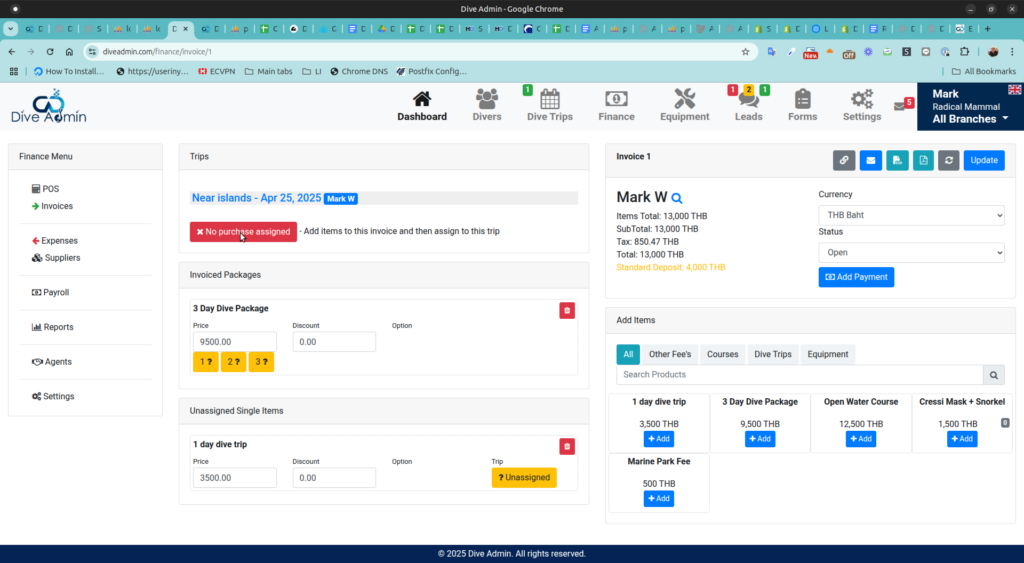
Manual Payments Are Costing Your Dive Center Thousands (Here's How to Fix It)
Manual payment processes in dive centers create hidden costs through lost staff time, revenue leaks, and customer frustration. Relying on fragmented systems for deposits, split payments, and invoicing wastes up to six hours weekly per staff member. Modern dive centers using integrated systems get paid faster, reduce errors, and present the professional image that today's divers expect from their digital booking experiences.
<b>Key Takeaways:</b>
- Manual payment handling costs dive centers about six hours of staff time per week
- Complex checkout workflows cause up to 70% of customers to abandon online purchases
- Integrated payment systems eliminate revenue leaks from missed charges and lost receipts
- Automated workflows improve your professional image and significantly reduce customer friction
- Real-time financial dashboards enable quick, data-driven decisions for better cash flow
It's high season. Your dive center is fully booked, but your staff is drowning in paperwork instead of the ocean. You spend the morning chasing down deposit payments, manually creating invoices, texting customers about outstanding balances, and reconciling credit card receipts with a messy spreadsheet.
While competitors are out building relationships with divers, your team is stuck playing accountant. These seemingly small administrative tasks actually cost you thousands in lost time, missed revenue, and frustrated customers.
The diving industry is rapidly digitalizing, but many centers still cling to manual systems. Ignoring the need to upgrade your payment processes puts you at a severe competitive disadvantage.

Why do messy payment processes cost dive centers money?
<b>Lost staff time:</b> Manual reconciliation, invoice creation, and payment chasing eat up valuable hours. According to a 2026 Beancount.io analysis, businesses that automate payment processes save over 500 hours per year. That works out to roughly six hours per week. Multiply those six hours by your average dive instructor's hourly rate, and you quickly see how expensive data entry truly is.
<b>Revenue leaks and errors:</b> When your staff is exhausted after a long day of diving, mistakes happen. Gear rental charges get forgotten. Deposit calculations go wrong. Duplicate refunds occur. These manual coordination loads lead to burnout and direct revenue loss.
<b>Customer friction and abandoned bookings:</b> Today's divers expect a seamless digital experience. According to research from the Baymard Institute in 2024, complex or slow checkout processes cause approximately 70% of customers to abandon their purchases online. That figure climbs even higher when divers try to book from their mobile phones.
<b>Lack of real-time financial visibility:</b> Disconnected systems prevent you from making quick decisions. When your accounting isn't linked to operational activities like gear rentals or course bookings, you lose the ability to manage cash flow effectively during the off-season.
What happens when your checkout process frustrates customers?
Modern divers book flights and hotels with a single tap on their phones. They bring those exact same digital expectations to your dive center. When they encounter friction, they notice.
<b>Common mistake:</b> Forcing a customer through multiple payment steps is a quick way to lose their trust. Unclear deposit deadlines, confusing split payments for group members, and forcing people to call or email just to pay their remaining balance all create unnecessary hurdles.
> "Omnichannel payments are kicking in because guests are demanding a frictionless experience. A lot of the time a booking is only a prepayment and they have to get their credit cards out again at the property and pay the rest. To modern consumers used to Amazon and Uber, it's annoying." – Carsten Wernet, CEO of SIHOT, Arena International (2025)
Smooth competitors easily capture the bookings you lose. A clunky payment system communicates that your business might be outdated or disorganized. With a growing percentage of divers booking their trips directly from their phones, a mobile-optimized experience is no longer optional.
How much time do manual payment processes really waste?
Let's look at a typical time audit for a manual payment workflow.
- Creating individual invoices: 5 minutes each
- Sending payment reminders: 3 minutes per customer
- Reconciling bank statements with bookings: 2 hours weekly
- Handling payment disputes or questions: 15 minutes per occurrence
- Processing refunds manually: 10 minutes each
- Tracking deposit balances: 2 hours weekly
Take a standard dive center processing 50 bookings per week. Those small blocks of time quickly add up to over six hours of administrative work. That translates to more than 312 hours annually. Research from Venn in 2025 found that knowledge workers spend up to 60% of their time on repetitive work tasks, often equivalent to dozens of hours weekly that modern software can handle in minutes.
<b>Bottom line:</b> You're paying staff wages for tedious data entry instead of revenue-generating activities. Every hour spent cross-referencing a spreadsheet is an hour not spent selling a new specialty course or upgrading a gear rental.

What does a smooth payment process look like for dive centers?
A modern setup completely changes how your team starts the day. Compare a manual Monday morning of sorting through emails and cross-checking bank transfers to an automated Monday morning where everything is already handled.
<b>Integrated platforms:</b> Good systems connect payments directly to your booking calendar. They generate invoices automatically and send digital receipts to the customer instantly.
<b>Flexible payment options:</b> You need workflows that support the reality of dive travel. This means taking upfront deposits, sending automatic balance reminders, and allowing split payments so each group member pays their own share. It also means supporting multiple payment gateways like Stripe.
<b>Automated communication:</b> Professional, branded receipts go out without you lifting a finger. Upcoming balance reminders happen in the background.
<b>Real-time tracking:</b> A proper financial dashboard shows you pending versus completed payments instantly. You can easily track revenue by service type, separating your Open Water courses from your daily fun dives and gear rentals.
How do automated payment systems improve professionalism?
First impressions happen long before a diver steps onto your boat. A branded booking page with secure payment processing looks professional. A paper invoice with a note to "call to pay your balance" looks amateur.
<b>Customer confidence signals:</b> Divers feel safer when they see SSL-secured payment processing, receive instant confirmation emails, and understand clear payment terms. They appreciate having professional financial records for their trip.
<b>Reducing no-shows:</b> When you collect a secured deposit upfront, you significantly reduce the chance of a customer skipping their dive. Automated reminders ensure they don't forget their booking.
According to SiteMinder research from 2025, creating a frictionless experience from the very first interaction transforms guests into loyal advocates who naturally promote your business. Smooth booking experiences get mentioned in positive reviews. Conversely, payment hassles are one of the fastest ways to earn a negative review before the customer even gets in the water.
Can better payment systems actually increase revenue?
Modernizing your checkout does more than save time. It directly increases your bottom line.
<b>Faster payment collection:</b> Immediate digital payments mean better cash flow. You no longer have to wait days for manual processing or chase down outstanding balances.
<b>Fewer missed charges:</b> Automated systems capture upsells beautifully. Customers can add nitrox, rental gear, or photography packages during checkout, ensuring no add-ons are forgotten by busy staff.
<b>Higher conversion rates:</b> An easier checkout process leads directly to more completed bookings. If you capture even 10% to 15% more conversions simply by having a mobile-optimized payment page, that translates into thousands of dollars in extra monthly revenue.
<b>Capacity for growth:</b> Think about the potential of freeing up six hours of staff time per week. That's enough time to sell and coordinate an entirely new boat trip or teach an extra certification course.
What should dive center owners look for in payment software?
Choosing the right software requires knowing exactly what your operation needs to run smoothly.
<b>Step 1:</b> Look for integration. Your payment software must integrate seamlessly with your booking and scheduling systems. It should never be a standalone tool.
<b>Key features to demand:</b>
- Support for deposits and balance payment workflows
- Split payment capability for groups
- Automated payment reminders and digital receipt generation
- Mobile-responsive payment pages
- Real-time reporting dashboards
- Simple refund processing capabilities
<b>Red flags to avoid:</b> Stay away from systems that require double-entry of customer data or lack mobile optimization. Avoid complex setups that require heavy technical expertise, hidden transaction fees, or poor customer support.
<b>When to use this:</b> Modern platforms like Dive Admin connect all these pieces together. By combining your booking, payment, and customer management into one unified ecosystem, you avoid the headache of juggling five different tools. Transitioning requires some staff training, but the immediate reduction in daily chaos is worth the short learning curve.
Is switching payment systems worth the hassle?
Changing how you handle money feels intimidating. It's normal to resist overhauling your systems.
You might think that because you've always done it this way, it works. But define what "works" really means. Surviving the daily admin grind isn't the same as operating optimally.
Another common objection is the lack of time to learn new software. However, the time invested upfront is tiny compared to the hundreds of hours you'll save each year. You might also worry that your customers are used to the current process. The truth is, customers actually prefer easier digital payments. They just rarely complain about the old way directly to your face.
<b>The real question:</b> Don't ask if you can survive with your current system. Ask yourself what growth you're leaving on the table.
You got into the diving industry to share incredible ocean experiences, not to sit in a back office acting as a bookkeeper. Upgrading your systems is a competitive necessity, not just a luxury upgrade.
From surviving the admin grind to thriving
Let's recap the hidden costs. Clunky, manual payment processes drain your staff's energy, leak revenue through missed charges, and frustrate modern divers who expect seamless digital checkouts.
The competitive landscape is dividing into two camps: dive centers that modernize their customer experience, and those that refuse to adapt. Payment processing is no longer just a back-office function. It's a critical part of your overall customer experience.
Imagine running a dive center where you're actually excited to check your financial dashboard, rather than dreading the massive pile of paperwork waiting on your desk. Tools like Dive Admin act as business partners, handling the tedious administrative work so you can focus on scaling your operation.
What would you do with an extra 300 hours per year? Your passion is the ocean. Let technology handle the rest.
FAQ
How much does automated payment software cost for dive centers?
Pricing models vary widely across the industry. Most platforms charge a monthly subscription fee, a per-transaction percentage, or a hybrid of both. While budget options exist, comprehensive integrated solutions typically pay for themselves within two to three months just through the staff time saved. Integrated platforms like Dive Admin often cost less overall than paying for multiple separate tools for booking, waivers, and invoicing.
Will my customers have trouble with a new payment system?
Modern payment systems are designed specifically for user-friendliness. The vast majority of your customers already prefer digital payments and expect them when booking travel. Good software requires far fewer steps from the customer than a manual process. If you choose a mobile-optimized platform, most divers won't even notice the switch. They'll simply find booking their next dive much easier.
How long does it take to set up integrated payment processing?
Setting up a cloud-based payment system usually takes days, not weeks. The process involves connecting your preferred payment gateway, importing your customer data, and configuring your specific deposit rules. Modern software is built for non-technical users. You can even choose a phased rollout, allowing your team to get comfortable with the new system while immediately enjoying the benefits for all incoming new bookings.
Can payment software handle complex dive center scenarios like group bookings and course installments?
Yes. Modern systems are built to handle the exact complexities of the diving industry. They easily manage split payments between group members, automated deposit and balance workflows, and installment plans for expensive instructor certifications. A good platform will automatically coordinate a customer's gear rental charges with their boat dive bookings without breaking a sweat.
What happens to my existing customer payment data when I switch systems?
Most established platforms offer dedicated import tools to handle your data migration smoothly. Your outstanding balances can be securely transferred, and all historical customer records are preserved. Many dive centers run a short hybrid period where both systems run parallel to ensure absolutely no revenue is lost during the transition. Your customers' payment history remains intact and accessible.