Are Last-Minute Dive Bookings Hurting Your Center or Helping It?
<b>TL;DR:</b> Last-minute dive bookings expose operational weaknesses in manual systems but become highly profitable revenue streams with the right technology. Cloud-based dive center software automates bookings, waivers, and scheduling to capture spontaneous reservations 24/7 while eliminating the 2-4 hours staff waste daily on manual reconciliation.
<b>Key Takeaways:</b>
- Real-time booking software captures reservations 24/7, preventing lost revenue when staff are busy on boats
- Manual systems cause staff to waste 2-4 hours daily reconciling bookings across apps, spreadsheets, and notebooks
- Automated digital waivers shift administrative work from front desk staff to pre-arrival customer completion
- Cloud-based platforms provide data-driven insights on occupancy rates to replace gut-feeling management
- Spontaneous bookings become profitable when supported by integrated scheduling, POS, and communication tools
It's 9:00 PM on a Friday. You're finally off the boat. The gear is washed, the tanks are filling, and you're ready to go home. Then your phone buzzes. A family of four wants to book a morning dive trip for tomorrow.
Do you scramble to check availability across three different spreadsheets? Do you text your boat captain to see if there's enough space? Or do you confidently confirm the reservation and collect payment in seconds?
Last-minute dive bookings represent a massive opportunity for extra revenue. They also expose every operational weakness in your business. When travelers make spontaneous decisions, they expect instant answers. If your systems are slow, disconnected, or rely entirely on human memory, you'll drop the ball. The difference between chaotic mornings and profitable margins comes down to the technology running your front desk.
Why Do Last-Minute Dive Bookings Create Chaos?
Handling spontaneous reservations manually is a recipe for disaster. The friction happens when digital expectations clash with analog workflows.
The "Productivity Killer Trio"
Most traditional dive centers run on a predictable tech stack. WhatsApp for communication. Google Sheets or Excel for scheduling. A paper clipboard for the boat manifest. This fragments your customer data across three totally different platforms.
<b>Common mistake:</b> Relying on human memory to bridge the gap between these systems. A customer messages you on WhatsApp and you verbally promise them a spot. They pay via a PayPal link. The staff member forgets to write their name on the paper boat manifest. The next morning, the boat is overbooked by two seats.
Staff spend an average of 2-4 hours daily on manual reconciliation tasks. Cross-checking payment channels, verifying liability forms, and hunting down missing medical questionnaires destroys your team's productivity.
The "Tired Thumbs" Syndrome
Making critical business decisions via phone messages late at night is dangerous. Travelers often book their activities while in transit or relaxing at the hotel bar after hours. They want answers immediately.
When you reply manually from your couch at 10:30 PM, mistakes happen. You might forget to ask for a 12-year-old's exact certification level. You might skip the standard medical questionnaire screening. You might forget to verify if you actually have enough extra-large wetsuits in the rental locker. These compressed decision windows lead to errors that impact diver safety and customer satisfaction.
Lost Revenue You Can't See
Manual systems can't capture bookings outside of your physical business hours. If a tourist is browsing options by the hotel pool at 11 PM, they'll book with the competitor who offers instant online checkout.
Without real-time availability displayed on your website, inquiries go entirely unanswered while your staff are underwater. Seats go unfilled simply because your availability wasn't updated across all your marketing channels.
> "Tour operators need an accounting system that integrates with their business processes, not just a generic tool that requires constant manual input. The cost should be weighed against the time and effort saved. Manual reconciliation and reporting can take hours each week."
> — Murray, CEO of Tour Amigo
This friction directly limits your growth. Every delayed email reply is a potential customer giving up and looking elsewhere.
How Much Revenue Are Dive Centers Actually Losing?
The financial impact of poor booking systems is easy to quantify. The modern traveler has zero patience for friction.
According to a 2023 Phocuswright report on travel booking behavior, the majority of travelers abandon bookings when the process feels clunky or response times drag on. Research from SiteMinder shows that around half of travelers abandon bookings due to a bad digital experience, citing difficult payment processes as a primary reason.
Let's break down the opportunity cost for a typical dive center. Assume your primary dive boat holds 15 divers and runs 300 days a year.
- <b>Step 1:</b> Calculate your average profit per seat. Let's say it's $50.
- <b>Step 2:</b> Look at your empty seats. If you leave just two seats empty per trip because your staff couldn't answer WhatsApp inquiries fast enough, you lose $100 a day.
- <b>Step 3:</b> Multiply that by 300 operating days.
That's $30,000 in lost profit annually. That money vanishes simply because a customer wanted to book at the exact moment your front desk person was out filling tanks. Automated 24/7 booking systems capture those spontaneous decisions, turning empty bench space into pure profit.
What Makes Last-Minute Bookings Profitable Instead of Painful?
The solution requires a complete shift from manual data entry to automated synchronization. Modern dive center software changes the entire workflow.
The Single Source of Truth
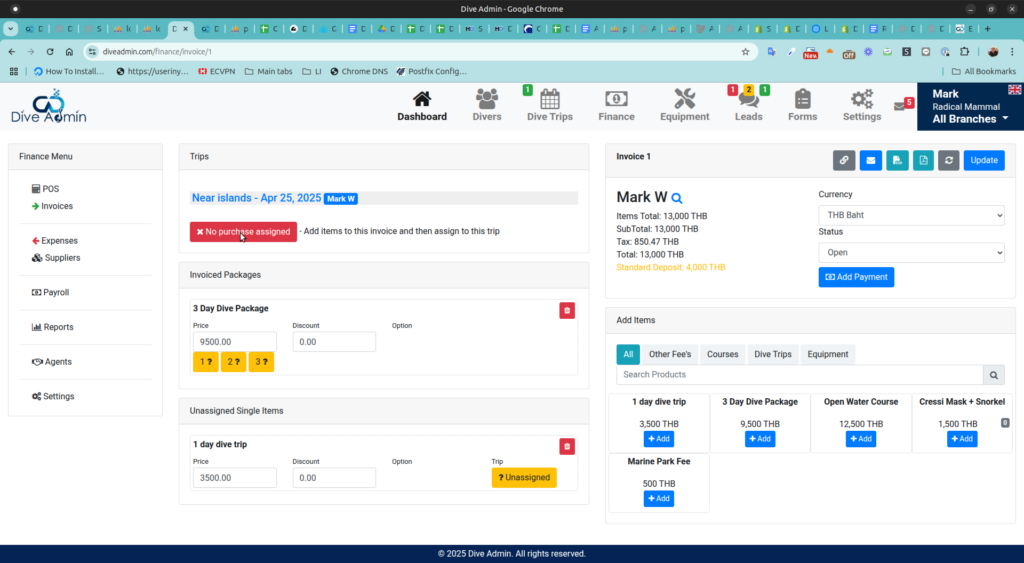
Modern management systems consolidate your online booking engine, point-of-sale (POS) hardware, and scheduling calendar into one unified platform.
<b>Key takeaway:</b> When a customer books a trip online, the system instantly updates the master schedule, adjusts the digital boat manifest, and records the payment. Nobody has to copy and paste anything. The software acts as a single source of truth for your entire team.
If a walk-in customer buys the last two spots on the morning wreck dive, the website instantly shows that trip as sold out. This eliminates double-bookings permanently.
Automation That Works While You Sleep
Your website should act as your best salesperson. A branded booking page with real-time seat availability allows customers to reserve spots at 2:00 AM.
The software automatically charges their credit card and emails them a confirmation receipt. The system then automatically emails the customer a link to their digital liability waivers and medical registration forms.
This shifts the administrative burden entirely. Instead of your front desk staff chasing down paperwork while a boat is idling at the dock, the customer completes everything on their phone before they even arrive at the shop. The 2-4 hours your staff used to spend on paperwork can now be spent upgrading gear sales and actually chatting with guests.
How Does Dive Center Software Handle Last-Minute Changes?
A common fear among dive shop owners is that automated systems will break down when schedules inevitably change. The reality is quite the opposite. Software actually absorbs the shock of sudden changes much better than a paper clipboard.
When Someone Cancels at the Last Second
Cancellations are a frustrating reality. A customer wakes up with a blocked ear and calls to cancel an hour before departure.
With integrated software, your staff clicks one button to remove them from the manifest. The system immediately references your customized cancellation policy. It can automatically issue a partial refund or hold the deposit as store credit. More importantly, those seats instantly reappear as available on your website. If someone else is looking for a last-minute dive booking online, they can grab those spots immediately.
When Weather Changes Plans
Weather forces rapid schedule changes. High winds might ruin your offshore trip, forcing you to move 15 divers to a protected reef site.
<b>When to use this:</b> Bulk rescheduling tools are lifesavers here. Instead of calling 15 different customers, the software allows you to move the entire boat roster to a new time or date with two clicks. The system automatically sends an SMS and email alert to every affected customer. It keeps your team perfectly aligned without the usual morning shouting match.
What Data Should You Actually Be Tracking?
You can't improve what you don't measure. Moving away from manual operations allows you to stop managing by gut feeling and start managing with hard data.
Modern software quietly tracks everything in the background.
<b>Vital metrics to monitor:</b>
- <b>Average occupancy per trip:</b> Are you constantly running boats at 60 percent capacity?
- <b>Late cancellation rates:</b> Track which marketing channels bring in the flakiest customers.
- <b>Response time to inquiries:</b> Measure how long it takes your team to reply to custom quote requests.
- <b>Revenue per available seat (RevPAS):</b> Total revenue divided by total boat seats over a month.
- <b>Booking lead time patterns:</b> Learn exactly when your customers prefer to book.
<b>Practical application:</b> If your data shows that 40 percent of your bookings happen within 48 hours of departure, you can adjust your staff scheduling. If you notice a high late-cancellation rate on local weekend trips, you can program your software to require non-refundable deposits specifically for Saturday departures.
Is Your Center Ready for Spontaneous Bookings?
Evaluating your current setup requires radical honesty. Ask yourself these diagnostic questions to see if your operation is resilient enough to handle spontaneous volume.
- Can customers successfully book and pay when you're asleep?
- Do you know your exact real-time boat availability without checking two different screens?
- Can your customers complete their PADI or SSI medical waivers on their phones before arrival?
- Does your boat captain see the exact same manifest on their phone as the office staff sees on the desktop?
- Can you generate an accurate equipment packing list in under 30 seconds?
- Do you know instantly which bookings are fully paid, which have a deposit, and which owe a balance?
<b>Bottom line:</b> If you answered "no" to more than two of these questions, you're actively losing revenue to competitors who offer faster booking. If you answered "no" to more than four, your business is operating in high-risk territory for safety compliance and payment disputes.
Real-World Results: Centers That Made the Switch
Theoretical benefits sound great, but real dive centers see tangible results when they abandon paper processes.

Consider a typical mid-sized Caribbean operation running two boats. Before switching to integrated software, their front desk manager spent every morning cross-referencing WhatsApp messages against PayPal receipts. They regularly lost 3-4 seats a week simply because they forgot to reply to late-night inquiries.
After implementing an all-in-one digital system, the center saw immediate changes.
- <b>Revenue bump:</b> Last-minute dive bookings increased by 22 percent because their live inventory was always visible online.
- <b>Time saved:</b> The front desk team reclaimed 15 hours a week previously spent on manual data entry.
- <b>Better mornings:</b> Boat departures left on time because 90 percent of customers completed their digital waivers the night before.
The return on investment usually happens quickly. The extra revenue generated from capturing just three last-minute bookings per month generally covers the entire monthly cost of a premium dive center software platform.
What Actually Changes Day-to-Day When You Make the Shift?
Fear of change holds many owners back. They worry that new technology will frustrate their staff or destroy the personal touch of a small business.
The day-to-day reality is entirely positive. Your staff will spend far less time doing boring data entry. They'll no longer have to decipher terrible handwriting on wet paper medical forms. Customers experience a much smoother process. They arrive at the shop, check in verbally, get handed their correct rental gear sizes, and walk to the boat.
<b>Common concerns addressed:</b>
- <b>"Our team isn't tech-savvy."</b> Modern systems like Dive Admin are built specifically for dive professionals, not IT experts. The interfaces resemble the apps you already use on your phone.
- <b>"We'll lose our personal touch."</b> Automation handles the robotic tasks. This actually frees up your human staff to have real conversations with guests about local marine life and equipment upgrades.
- <b>"The transition will disrupt business."</b> You don't have to switch everything on a Tuesday morning. Start by running your new booking engine in parallel with your old system for a week.
<b>Step 1 for transitioning:</b> Start with one core function. Implement online booking and digital waivers first. Once your staff is comfortable, roll out the automated equipment sizing and retail POS features.
The Bottom Line: Last-Minute Bookings as a Growth Strategy
It's time to stop viewing last-minute dive bookings as a logistical headache. They're a high-margin growth opportunity.
Centers that can say "yes" instantly have a massive competitive advantage over shops that are still waiting for a manager to check a spreadsheet. Instant confirmation is no longer a luxury feature. It's a basic expectation for the modern traveler.
By automating the flow from booking to boarding, you maximize your existing capacity. You don't need to buy bigger boats or hire more instructors to increase your revenue. You just need to flawlessly fill the empty seats you already have. Build a reputation for seamless availability, and those spontaneous inquiries will quickly turn into loyal repeat customers.
FAQ
How do I accept last-minute dive bookings without creating scheduling chaos?
Use integrated dive center software that syncs your website, scheduling calendar, and point-of-sale system. When a booking comes in, the software automatically updates real-time availability across all devices, preventing double-bookings. This single source of truth keeps boat manifests accurate without manual cross-checking.
What dive center software works best for last-minute bookings?
Look for platforms that combine online booking engines, digital waiver management, and staff scheduling in one place. Solutions like Dive Admin are highly effective because they eliminate data fragmentation. Ensure the platform offers a mobile-friendly view so your boat captains can see live updates directly from the dock.
Can automated booking systems handle custom requests and special requirements?
Yes. Modern booking flows use customizable digital forms to collect critical details immediately after checkout. You can require customers to input their exact certification agency, number of logged dives, dietary restrictions, and specific rental equipment sizes. This is often more accurate than taking notes during a rushed phone call.
How much time does dive center software actually save?
Most dive centers report saving between 2 and 4 hours every single day. This time is usually reclaimed by eliminating manual tasks like chasing down payment confirmations, cross-referencing multiple calendars, and re-typing customer details onto paper boat manifests.
Will customers actually book dives online at the last minute?
Absolutely. Modern travelers make decisions in highly compressed windows, often from their mobile phones while already at the destination. Centers offering instant online booking and secure checkout routinely capture late-night reservations that manual operations miss completely.